
The Snares
Explore The Snares of New Zealand
These Antipodes Islands of the South Pacific, The Snares, consist of one main island (North East Island) surrounded by several smaller islands and rocks (e.g. Broughton Island, Alert Stack, the Daption Islands in the north), and a group of islands that are known as the Western Chain. The islands of the Western Chain all carry Maori names: Tahi (one); Rua (two); Toru (three); Wha (four) and finally Rima (five).
All of The Snares Islands group are bordered by steep cliffs, except for a few eastern parts. The climate is mainly influenced by a warm current coming in from Australia and the mean annual temperature is a mild, at 11°C or 52F. Rainfall is about 1200 millimetres or 47 inches per year.
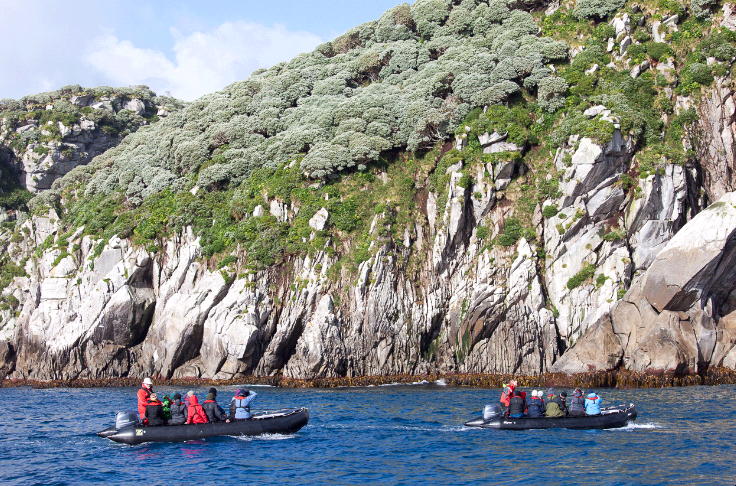
The Snares Islands are part of the New Zealand Subantarctic World Heritage Site and are a nature reserve under the Reserves Act of 1977, with landing only by permit. Extreme precautions are taken to prevent non-indigenous plant or animal infestation. Access is only for research and tourists can only view wildlife by boat.
Explore The Snares of New Zealand
These Antipodes Islands of the South Pacific, The Snares, consist of one main island (North East Island) surrounded by several smaller islands and rocks (e.g. Broughton Island, Alert Stack, the Daption Islands in the north), and a group of islands that are known as the Western Chain. The islands of the Western Chain all carry Maori names: Tahi (one); Rua (two); Toru (three); Wha (four) and finally Rima (five).
All of The Snares Islands group are bordered by steep cliffs, except for a few eastern parts. The climate is mainly influenced by a warm current coming in from Australia and the mean annual temperature is a mild, at 11°C or 52F. Rainfall is about 1200 millimetres or 47 inches per year.
The Snares Islands are part of the New Zealand Subantarctic World Heritage Site and are a nature reserve under the Reserves Act of 1977, with landing only by permit. Extreme precautions are taken to prevent non-indigenous plant or animal infestation. Access is only for research and tourists can only view wildlife by boat.
READ LESS
Geography
Geographical Information: 48º 02’S, 166º 35’E, in the South Pacific Ocean, 200 kilometres south-west of New Zealand
Area: 328 ha
Maximum Altitude: 152 metres
Physical Features: The Snares Island group is formed of basement granite and metamorphic rocks. Soils are mostly blanket peat, up to 8 metres (26 feet) thick. The coastline has the normal features of exposed islands composed of unstratified rocks. On the west coast of North East Island, the cliffs rise nearly vertical to a height of 350 metres (1,150 feet). The eastern cliffs are not so high, and in one location are so low that a boat landing can be made – this is called 'Boat Harbour'.
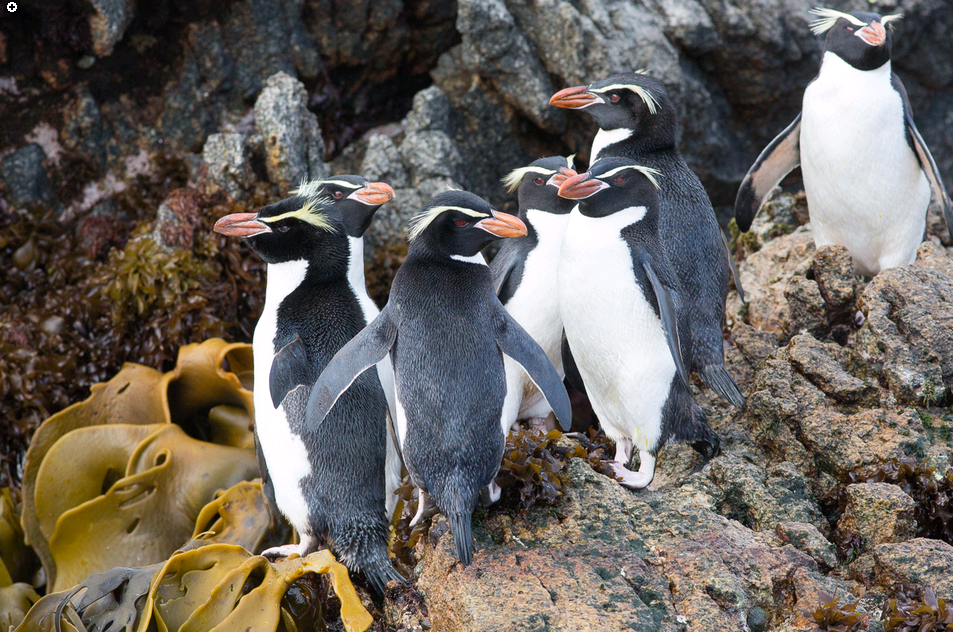
Snares Crested Penguins in Kelp Beds
A small stream enters at the head of this cove, suggesting that it is the submerged portion of a stream valley eroded when the level of the land was somewhat higher than now. The surface is entirely covered with peat to an average depth of two metres (6½ feet). The smaller south-west portion is almost flat and appears to be an old plain of marine erosion indicating a former lower level of the land.
Geographical Information: 48º 02’S, 166º 35’E, in the South Pacific Ocean, 200 kilometres south-west of New Zealand
Area: 328 ha
Maximum Altitude: 152 metres
Physical Features: The Snares Island group is formed of basement granite and metamorphic rocks. Soils are mostly blanket peat, up to 8 metres (26 feet) thick. The coastline has the normal features of exposed islands composed of unstratified rocks. On the west coast of North East Island, the cliffs rise nearly vertical to a height of 350 metres (1,150 feet). The eastern cliffs are not so high, and in one location are so low that a boat landing can be made – this is called 'Boat Harbour'.
Snares Crested Penguins in Kelp Beds
A small stream enters at the head of this cove, suggesting that it is the submerged portion of a stream valley eroded when the level of the land was somewhat higher than now. The surface is entirely covered with peat to an average depth of two metres (6½ feet). The smaller south-west portion is almost flat and appears to be an old plain of marine erosion indicating a former lower level of the land.
READ LESS

History
Curiously, the Snares Island Group was discovered on 23 November 1791 independently by two ships: HMS Discovery under Captain George Vancouver and HMS Chatham commanded by Lieutenant William R. Broughton, both of the Vancouver Expedition. Vancouver named the islands ‘The Snares’ because he considered them a shipping hazard. An islet east of the Western Chain bears the name Vancouver Rock, and the second-largest island is named after Lieutenant Broughton. The islands were already known to the Maori, who called one of the larger islands Te Taniwha (‘The sea-monster’). Unlike other Subantarctic Islands that were greatly affected by the whaling and sealing industry in the 19th century, The Snares remain one of the last pristine areas in New Zealand.
The Snares are the only Subantarctic Island group that is free from any introduced terrestrial mammals (e.g. rats, rabbits) apart from humans, of course. And, in the past, even humans seldom showed up, which was different from the other islands that were either used as whaling or sealing bases, or as farming grounds. The Snares were never inhabited by humans, well not voluntarily!
During the middle of the 19th Century a sealer’s ship sailed from Australia southwards, en route to the rich sealing grounds of the Subantarctic. Somewhere on the Tasman Sea, four stowaways were discovered in the bowels of the ship, which proved to be a bunch of convicts that had escaped from an Australian prison. Back in the old days, sealers were made out of tough material themselves and so, to avoid any delays, the four convicts were simply integrated into the sealing gang. Unfortunately, shortly after the discovery of the four, the sealers realised that their food supplies where about to run short. So the captain made the decision that the four convicts might as well take care of the seal population on the nearby Snares Islands while the rest of the crew would carry on to reach their destination further south. “We’ll be back in a couple of weeks and pick you and your booty up again. How’s that?” asked the captain. The four convicts, funnily enough, were thrilled and landed equipped with sealing batons and trypots (for boiling seal blubber) on The Snares. They probably even waved happily as the sealer disappeared on the horizon, before the four started their bloody work.
Five years later, a different sealer made a stopover on The Snares. The crew was surprised when all of a sudden three bearded, ragged-looking men stumbled out of the bush. Generously, they were taken to the New Zealand mainland, where their story caused some stir. Apparently, one of the four went mad while on the islands. The other three decided he would be better off if they threw him over a steep cliff edge. The New Zealand courts, however, did not share their opinion and charged all three with murder.
Curiously, the Snares Island Group was discovered on 23 November 1791 independently by two ships: HMS Discovery under Captain George Vancouver and HMS Chatham commanded by Lieutenant William R. Broughton, both of the Vancouver Expedition. Vancouver named the islands ‘The Snares’ because he considered them a shipping hazard. An islet east of the Western Chain bears the name Vancouver Rock, and the second-largest island is named after Lieutenant Broughton. The islands were already known to the Maori, who called one of the larger islands Te Taniwha (‘The sea-monster’). Unlike other Subantarctic Islands that were greatly affected by the whaling and sealing industry in the 19th century, The Snares remain one of the last pristine areas in New Zealand.
The Snares are the only Subantarctic Island group that is free from any introduced terrestrial mammals (e.g. rats, rabbits) apart from humans, of course. And, in the past, even humans seldom showed up, which was different from the other islands that were either used as whaling or sealing bases, or as farming grounds. The Snares were never inhabited by humans, well not voluntarily!
During the middle of the 19th Century a sealer’s ship sailed from Australia southwards, en route to the rich sealing grounds of the Subantarctic. Somewhere on the Tasman Sea, four stowaways were discovered in the bowels of the ship, which proved to be a bunch of convicts that had escaped from an Australian prison. Back in the old days, sealers were made out of tough material themselves and so, to avoid any delays, the four convicts were simply integrated into the sealing gang. Unfortunately, shortly after the discovery of the four, the sealers realised that their food supplies where about to run short. So the captain made the decision that the four convicts might as well take care of the seal population on the nearby Snares Islands while the rest of the crew would carry on to reach their destination further south. “We’ll be back in a couple of weeks and pick you and your booty up again. How’s that?” asked the captain. The four convicts, funnily enough, were thrilled and landed equipped with sealing batons and trypots (for boiling seal blubber) on The Snares. They probably even waved happily as the sealer disappeared on the horizon, before the four started their bloody work.
Five years later, a different sealer made a stopover on The Snares. The crew was surprised when all of a sudden three bearded, ragged-looking men stumbled out of the bush. Generously, they were taken to the New Zealand mainland, where their story caused some stir. Apparently, one of the four went mad while on the islands. The other three decided he would be better off if they threw him over a steep cliff edge. The New Zealand courts, however, did not share their opinion and charged all three with murder.
READ LESS
Flora & Fauna
Flora: Deep, dry peat soils cover almost the entire landscape. They support forest, scrub, grassland or herb fields. In poorly drained valleys and on plateaus, deep raised bogs have formed, with tussock or cushion bog vegetation.
The Snares Islands are remarkable in that their vegetation is essentially unmodified by humans or alien animals. The tall shrub daisy Olearia lyallii dominates scrub and low forest on The Snares. Known as Muttonbird Scrub, and climbing to 5 metres (16½ feet) tall, its interior is a mass of sprawling stems and roots, riddled with petrel (Muttonbird) burrows.
There are two distinct meadow formations; one where Poa foliosa is dominant, and the other where Poa litorosa is prevalent. The Poa foliosa meadows stand out conspicuously, with their penetrating green appearance. The plants grow in close formation with the broad leaves drooping. Stilbocarpa robusta grows occasionally as an isolated specimen, whereas in other areas of the island, it is found mixed with Asplenium and Blechnum ferns. These communities occupy the hollows and sheltered locations. Where the westerly wind strikes with full force and damages these meadows, they are succeeded by Poa litorosa. These meadow structures are characterised for their brown appearance, rounded and close-headed tussocks, growing on trunks that measure 57 centimetres (22½ inches) or higher.
Located in the coastal areas are many vivid green cushions of Colobanthus muscoides. Rock crevices are filled with the succulent Tillaea moshata, which forms bright green mats on the adjacent peaty ground.
No landings are permitted on The Snares but Zodiac cruising gives great views of the three of endemics. These are the Snares Crested Penguin, the Snares Tomtit and the Fernbird.
Because of the complete absence of terrestrial mammals, The Snares form an intact habitat for birds and seals (which have recovered from sealing days). Seabirds use virtually every square metre on the islands for nesting and resting. Sooty Shearwaters, or Titi, are by far the most numerous species, with up to 5 million birds populating The Snares in the summer months. The islands’ peat soils are literally undermined with Titi burrows. At dusk, thousands of Titi’s fill the air before the elegant gliders (whose landing capabilities are shockingly bad) crash through the canopy to reach their nests.
The second most numerous seabird species are Common Diving-Petrels, or Kuaka, that find their southern limit of distribution on The Snares. In total, three albatross species breed on the islands. The most colourful and numerous of the three, at 18,000 individuals, is Buller’s Albatross. Other coastal seabirds include Antarctic terns, skuas and Black-backed (or Dominican) Gulls.
The Snares Crested Penguin breeds – as its common name suggests – only on The Snares Islands. The total population consists of about 60,000 individuals dispersed in approximately 100 different colonies. These spread or contract according to the number of penguins in them each season. Where penguins breed, the vegetation dies, but recovers as a colony slowly shifts its position during the years.
Two species of marine mammal occur on The Snares: the New Zealand Fur Seal and the New Zealand (Hooker’s) Sea Lion.
Snares Crested Penguin and the Snares Island Project
One of the Snares Islands’ endemic animal species is the Snares Crested Penguin, Eudyptes robustus. An estimated 23,000 to 26,000 pairs breed on North East Island and Broughton Island. A recent census indicated stable if not slightly increasing numbers.
Despite that, the IUCN (International Union for Conservation of Nature and Natural Resources) considers the Snares Crested Penguin a ‘vulnerable’ species and lists it accordingly in the ‘red list’ of threatened species. Being confined to just The Snares as its only breeding site makes the penguin susceptible to many natural perturbations (e.g. changes in prey abundance, biotoxins that often come along with plankton blooms, climatic effects like the El Niño and La Niña phenomena) or human-induced catastrophic events (e.g. oil spills, competition with fisheries).
In order to be prepared for conservation actions in the event of an emergency, there is a need to understand at least the basic biology of the Snares Crested Penguin. And this is exactly what The Snares Islands Project sets out to achieve. The project is planned as a long-term study and aims to understand the population dynamics in Snares Crested Penguins. To learn about the variability of the penguins’ reproductive outcome, it is necessary to observe the breeding success over the next few years (how many eggs are laid each season, how many of these eggs produce chicks and how many of the chicks survive to eventually fledge).
Another facet researchers examine is the phenomenon known as ‘brood reduction’ in crested penguins. All of the six crested penguin species generally lay two eggs, but most of the time only one chick survives. However, the odd thing is that the first egg laid is always smaller than the second egg (‘egg dimorphism’). And although the second egg quite often is laid up to six days later than the first egg, it is usually first to hatch a chick. Some reports indicate that crested penguins sometimes deliberately remove the first egg from their nest. Considering this, the question arises why crested penguins ‘waste’ a lot of energy to produce egg number one in the first place…could it be that they occupy a position – from an evolutionary viewpoint – somewhere between Emperor and King Penguins, who only lay one egg, and the other penguin species, who always lay two eggs?
Snares Crested Penguin has a broad crest extending from the beak to the back of the head. It has a thicker, heavier bill which is underlined with white skin and a broad crest growing from the beak over the top to the back of the head. It can be somewhat difficult to distinguish the Snares Crested Penguin from some of the other crested penguins, especially while they are at sea. The Snares Crested Penguin does not have the white cheek feathers found on the Fiordland Crested Penguin. Also, its crest is not as erect as that of the Erect-Crested Penguin and less elaborate than that of the Rockhopper Penguin. Male and female ‘Snares’ are monomorphic and it can be difficult to differentiate the sexes without behavioural clues.
These penguins eat a variety fish, squid and krill which populate the warm waters of southern New Zealand. As most penguin species do, they feed by shallow pursuit diving, using their webbed feet and strong flippers to propel them through the water at speeds up to 24 kilometres (15 miles) per hour. Snares Crested Penguin colonies range in size from 10 to 1,200 nests. The male returns to the nesting area in August to build a mounded nest bowl from stones, earth, sticks and vegetation. The Snares Crested Penguin is very territorial, fighting over nesting areas for about a month. The female arrives after the male, and the eggs are laid between late September and early October.
Ten days after the eggs are laid, the male breaks his six-week fast and goes to sea to feed for 12 days while the female incubates. When he returns, she breaks her 39 day fast and goes to sea for 10 days. The chicks hatch after 31 to 37 days. The male guards the chicks after they hatch and the female forages every day, returning to feed them but not her mate. After about 20 days both parents forage and feed the young daily, however, in most cases one chick has died by this stage. While the parents are at sea during the day, chicks are in a crèche, protected by juveniles and non-breeding adults.
Fledging occurs after about 75 days when the new members of the family take to the sea to immediately start fending for themselves, preying on krill, squid and small fish. A fledgling will grow to a 3.4 kilogram, 55 centimetre (7½ pounds, 21½ inch) adult, but will not breed until it is 6-years-old.
Sooty Shearwater
The Sooty Shearwater, Puffinus griseus, is a medium to large shearwater in the seabird family Procellariidae. In New Zealand it is also known by its Māori name Tītī or Muttonbird, like the Wedge-tailed Shearwater and the Australian Short-tailed Shearwater.
This bird is 40-50 centimetres (16 to 20 inches) in length with a 95-110 centimetre (37½ to 43 inch) wingspan. It has the typically ‘shearing’ flight of the genus, dipping from side to side on stiff wings with few wing beats, the wingtips almost touching the water. Its flight is powerful and direct, with wings held stiff and straight, giving the impression of a very small albatross. This shearwater is identifiable by its dark plumage which is responsible for its name. In poor viewing conditions it looks all black, but in good light it shows as dark chocolate-brown with a silvery strip along the centre of the underwing. In the Pacific part of its range, other all-dark large shearwaters are found, but in the Atlantic, it is the only such bird.
The Sooty Shearwater is a spectacular long-distance migrant, following a circular route, travelling north up the western side of the Pacific and Atlantic Oceans at the end of the nesting season between March and May, reaching subarctic waters in June or July where they cross from west to east. They then return south down the eastern side of either ocean in September or October, reaching the breeding colonies in November. They do not migrate as a flock, but rather as single individuals, associating only opportunistically; in 1906 for example, two were shot near Guadalupe Island off Baja California (Mexico) several weeks before the bulk of the population would pass by.
The Sooty Shearwater feeds on fish and squid. It can dive up to 68 metres (225 feet) deep for food, but more commonly takes surface food, in particular often following whales to catch fish disturbed by them. It will also follow fishing boats to take fish scraps thrown overboard. It breeds in huge colonies, and the female lays one white egg. These shearwaters nest in burrows lined with plant material which are used only at night to avoid predation by large gulls.
The Sooty Shearwater was a very common bird around the southern New Zealand coast, circling in flocks of hundreds of birds about any school of herring. But by 2004 it had declined to less than 5 percent of 1980 numbers. About half a million per annum are slaughtered for food with juveniles being taken from the burrows as a food source. Customary practice was to break their wings and stuff their feet though a slash in the wing so that they would stay alive for some time and not deteriorate. They were then packed into carry bags made from giant kelp. They have been exterminated on the mainland, but some survive on outlying southern islands where they are relentlessly pursued. They migrate to the North Pacific in winter and return in September.
Snares Island Tomtit
The tiny Snares Island Tomtit, Petroica dannefaerdi, is a member of the passerine (perching bird) order. Passerines have four toes – three pointing forward and one back. Tendons running down the back of each leg draw the claws into a curled position when the bird bends its leg, so they grip a twig or branch easily.
The tomtit is one of four species of the genus Petroica found in New Zealand, the ancestors of which colonised from Australia. The species was once thought to have been descended from the Scarlet Robin, although more recent research has questioned this. It seems likely that there were two colonisation events, with the North Island Robin and the South Island Robin descended from one event and the Black Robin and tomtit from another.
There are five subspecies of the tomtit, each species being restricted to each of the following islands or island groups: North Island, South Island, The Snares, Chatham Islands and the Auckland Islands. Four of these five subspecies have been elevated to full species in the past (the Chatham subspecies was retained with the South Island Tomtit), but genetic studies have shown that these subspecies diverged relatively recently.
The tomtit is a small bird at 13 centimetres and 11 grams (5 inches and 0.4 pounds) with a large head and a short bill. The Snares Island subspecies is entirely black, and is known as the Black Tit. The tomtit is mostly an insectivore, feeding on small invertebrates such as beetles, caterpillars, spiders, moths, Weta, earthworms and flies. Fruit is taken during the winter and autumn. Most subspecies feed in vegetation, waiting on a perch and watching for prey. Insects are also gleaned from branches and leaves. The Snares subspecies feeds on the ground as well, in a similar fashion to the New Zealand Robin.
New Zealand Fur Seals
New Zealand Fur Seals, Arctocephalus forsteri, Kekeno, are the most common seals in New Zealand waters. They are renowned for their swimming ability are very good swimmers and weaned pups will turn up almost anywhere around New Zealand. A Fur Seal pup tagged on the west coast of South Island has even been recorded in Australia. On land they sometimes become disoriented and have been found in unusual places such as backyards, drains and streets.
In New Zealand, minimum estimates of the population are 50,000 to 60,000, but this is almost certainly an underestimate. Recent work in Otago has shown there was a population increase of 25 per cent per year between 1982 and 1994 and surveys in 1995 indicated this was continuing. A similar rate of increase has been noted in the Nelson/Marlborough region and also in the Subantarctic Bounty Islands. Fur seals recommenced breeding on the North Island in 1991. In Australia the latest estimates are 30,000 to 35,000 individuals, with an annual increase of 16 to 19 per cent.
Although there are no estimates of population growth available for Southland, a nationwide survey in the 1970s showed that fur seals in Southland accounted for over 40 per cent of the total New Zealand population, or 70 per cent if the Subantarctic Islands are included.
Kekeno feed mainly on squid and small mid-water fish, but also take larger species such as Conger Eels, Barracuda, Jack Mackerel and Hoki, mostly off the continental shelf in depths greater than 22 metres (72 feet). The New Zealand Fur Seal dives deeper and longer than any other fur seal.
Most of their prey species follow a vertical migration, i.e. they come near the surface in the middle of the night, and sink back to deeper depths during the day. The seals appear to follow these migrations when they forage. Their summer foraging is concentrated over the continental shelf, or near the slope. They will dive continuously from sundown to sunrise. In autumn and winter, they dive much deeper, with many dives deeper than 100 metres (330 feet). At least some females dive deeper than 240 metres (780 feet), and satellite tracking shows that they may forage up to 200 kilometres (124 miles) beyond the continental slope in water deeper than 1,000 metres (3280 feet).
Kekeno spend a lot of their time on rocky shores, at sites called haul outs. Every year, these sociable animals return to the same area for the breeding season. Females reach sexual maturity between four and six years and will give birth to a single pup more or less every year until their death at on average 14 to 17 years. Females mate six to eight days after the birth of their pup, even before their first foraging trip. Delayed implantation means the egg is fertilised, but does not implant in the uterine wall for another 3 months. Gestation is therefore about 9 months, even though the female is mated 360 days before she gives birth.
The breeding season is from mid-November to mid-January. Pups are suckled for about 300 days, though some will continue to suckle into their second year. Females alternate foraging trips (periods of one to 20 days at sea) to feed, with attendance periods (one to two days), where they are at the rookery to suckle the pup. After weaning, pups disperse.
Flora: Deep, dry peat soils cover almost the entire landscape. They support forest, scrub, grassland or herb fields. In poorly drained valleys and on plateaus, deep raised bogs have formed, with tussock or cushion bog vegetation.
The Snares Islands are remarkable in that their vegetation is essentially unmodified by humans or alien animals. The tall shrub daisy Olearia lyallii dominates scrub and low forest on The Snares. Known as Muttonbird Scrub, and climbing to 5 metres (16½ feet) tall, its interior is a mass of sprawling stems and roots, riddled with petrel (Muttonbird) burrows.
There are two distinct meadow formations; one where Poa foliosa is dominant, and the other where Poa litorosa is prevalent. The Poa foliosa meadows stand out conspicuously, with their penetrating green appearance. The plants grow in close formation with the broad leaves drooping. Stilbocarpa robusta grows occasionally as an isolated specimen, whereas in other areas of the island, it is found mixed with Asplenium and Blechnum ferns. These communities occupy the hollows and sheltered locations. Where the westerly wind strikes with full force and damages these meadows, they are succeeded by Poa litorosa. These meadow structures are characterised for their brown appearance, rounded and close-headed tussocks, growing on trunks that measure 57 centimetres (22½ inches) or higher.
Located in the coastal areas are many vivid green cushions of Colobanthus muscoides. Rock crevices are filled with the succulent Tillaea moshata, which forms bright green mats on the adjacent peaty ground.
No landings are permitted on The Snares but Zodiac cruising gives great views of the three of endemics. These are the Snares Crested Penguin, the Snares Tomtit and the Fernbird.
Because of the complete absence of terrestrial mammals, The Snares form an intact habitat for birds and seals (which have recovered from sealing days). Seabirds use virtually every square metre on the islands for nesting and resting. Sooty Shearwaters, or Titi, are by far the most numerous species, with up to 5 million birds populating The Snares in the summer months. The islands’ peat soils are literally undermined with Titi burrows. At dusk, thousands of Titi’s fill the air before the elegant gliders (whose landing capabilities are shockingly bad) crash through the canopy to reach their nests.
The second most numerous seabird species are Common Diving-Petrels, or Kuaka, that find their southern limit of distribution on The Snares. In total, three albatross species breed on the islands. The most colourful and numerous of the three, at 18,000 individuals, is Buller’s Albatross. Other coastal seabirds include Antarctic terns, skuas and Black-backed (or Dominican) Gulls.
The Snares Crested Penguin breeds – as its common name suggests – only on The Snares Islands. The total population consists of about 60,000 individuals dispersed in approximately 100 different colonies. These spread or contract according to the number of penguins in them each season. Where penguins breed, the vegetation dies, but recovers as a colony slowly shifts its position during the years.
Two species of marine mammal occur on The Snares: the New Zealand Fur Seal and the New Zealand (Hooker’s) Sea Lion.
Snares Crested Penguin and the Snares Island Project
One of the Snares Islands’ endemic animal species is the Snares Crested Penguin, Eudyptes robustus. An estimated 23,000 to 26,000 pairs breed on North East Island and Broughton Island. A recent census indicated stable if not slightly increasing numbers.
Despite that, the IUCN (International Union for Conservation of Nature and Natural Resources) considers the Snares Crested Penguin a ‘vulnerable’ species and lists it accordingly in the ‘red list’ of threatened species. Being confined to just The Snares as its only breeding site makes the penguin susceptible to many natural perturbations (e.g. changes in prey abundance, biotoxins that often come along with plankton blooms, climatic effects like the El Niño and La Niña phenomena) or human-induced catastrophic events (e.g. oil spills, competition with fisheries).
In order to be prepared for conservation actions in the event of an emergency, there is a need to understand at least the basic biology of the Snares Crested Penguin. And this is exactly what The Snares Islands Project sets out to achieve. The project is planned as a long-term study and aims to understand the population dynamics in Snares Crested Penguins. To learn about the variability of the penguins’ reproductive outcome, it is necessary to observe the breeding success over the next few years (how many eggs are laid each season, how many of these eggs produce chicks and how many of the chicks survive to eventually fledge).
Another facet researchers examine is the phenomenon known as ‘brood reduction’ in crested penguins. All of the six crested penguin species generally lay two eggs, but most of the time only one chick survives. However, the odd thing is that the first egg laid is always smaller than the second egg (‘egg dimorphism’). And although the second egg quite often is laid up to six days later than the first egg, it is usually first to hatch a chick. Some reports indicate that crested penguins sometimes deliberately remove the first egg from their nest. Considering this, the question arises why crested penguins ‘waste’ a lot of energy to produce egg number one in the first place…could it be that they occupy a position – from an evolutionary viewpoint – somewhere between Emperor and King Penguins, who only lay one egg, and the other penguin species, who always lay two eggs?
Snares Crested Penguin has a broad crest extending from the beak to the back of the head. It has a thicker, heavier bill which is underlined with white skin and a broad crest growing from the beak over the top to the back of the head. It can be somewhat difficult to distinguish the Snares Crested Penguin from some of the other crested penguins, especially while they are at sea. The Snares Crested Penguin does not have the white cheek feathers found on the Fiordland Crested Penguin. Also, its crest is not as erect as that of the Erect-Crested Penguin and less elaborate than that of the Rockhopper Penguin. Male and female ‘Snares’ are monomorphic and it can be difficult to differentiate the sexes without behavioural clues.
These penguins eat a variety fish, squid and krill which populate the warm waters of southern New Zealand. As most penguin species do, they feed by shallow pursuit diving, using their webbed feet and strong flippers to propel them through the water at speeds up to 24 kilometres (15 miles) per hour. Snares Crested Penguin colonies range in size from 10 to 1,200 nests. The male returns to the nesting area in August to build a mounded nest bowl from stones, earth, sticks and vegetation. The Snares Crested Penguin is very territorial, fighting over nesting areas for about a month. The female arrives after the male, and the eggs are laid between late September and early October.
Ten days after the eggs are laid, the male breaks his six-week fast and goes to sea to feed for 12 days while the female incubates. When he returns, she breaks her 39 day fast and goes to sea for 10 days. The chicks hatch after 31 to 37 days. The male guards the chicks after they hatch and the female forages every day, returning to feed them but not her mate. After about 20 days both parents forage and feed the young daily, however, in most cases one chick has died by this stage. While the parents are at sea during the day, chicks are in a crèche, protected by juveniles and non-breeding adults.
Fledging occurs after about 75 days when the new members of the family take to the sea to immediately start fending for themselves, preying on krill, squid and small fish. A fledgling will grow to a 3.4 kilogram, 55 centimetre (7½ pounds, 21½ inch) adult, but will not breed until it is 6-years-old.
Sooty Shearwater
The Sooty Shearwater, Puffinus griseus, is a medium to large shearwater in the seabird family Procellariidae. In New Zealand it is also known by its Māori name Tītī or Muttonbird, like the Wedge-tailed Shearwater and the Australian Short-tailed Shearwater.
This bird is 40-50 centimetres (16 to 20 inches) in length with a 95-110 centimetre (37½ to 43 inch) wingspan. It has the typically ‘shearing’ flight of the genus, dipping from side to side on stiff wings with few wing beats, the wingtips almost touching the water. Its flight is powerful and direct, with wings held stiff and straight, giving the impression of a very small albatross. This shearwater is identifiable by its dark plumage which is responsible for its name. In poor viewing conditions it looks all black, but in good light it shows as dark chocolate-brown with a silvery strip along the centre of the underwing. In the Pacific part of its range, other all-dark large shearwaters are found, but in the Atlantic, it is the only such bird.
The Sooty Shearwater is a spectacular long-distance migrant, following a circular route, travelling north up the western side of the Pacific and Atlantic Oceans at the end of the nesting season between March and May, reaching subarctic waters in June or July where they cross from west to east. They then return south down the eastern side of either ocean in September or October, reaching the breeding colonies in November. They do not migrate as a flock, but rather as single individuals, associating only opportunistically; in 1906 for example, two were shot near Guadalupe Island off Baja California (Mexico) several weeks before the bulk of the population would pass by.
The Sooty Shearwater feeds on fish and squid. It can dive up to 68 metres (225 feet) deep for food, but more commonly takes surface food, in particular often following whales to catch fish disturbed by them. It will also follow fishing boats to take fish scraps thrown overboard. It breeds in huge colonies, and the female lays one white egg. These shearwaters nest in burrows lined with plant material which are used only at night to avoid predation by large gulls.
The Sooty Shearwater was a very common bird around the southern New Zealand coast, circling in flocks of hundreds of birds about any school of herring. But by 2004 it had declined to less than 5 percent of 1980 numbers. About half a million per annum are slaughtered for food with juveniles being taken from the burrows as a food source. Customary practice was to break their wings and stuff their feet though a slash in the wing so that they would stay alive for some time and not deteriorate. They were then packed into carry bags made from giant kelp. They have been exterminated on the mainland, but some survive on outlying southern islands where they are relentlessly pursued. They migrate to the North Pacific in winter and return in September.
Snares Island Tomtit
The tiny Snares Island Tomtit, Petroica dannefaerdi, is a member of the passerine (perching bird) order. Passerines have four toes – three pointing forward and one back. Tendons running down the back of each leg draw the claws into a curled position when the bird bends its leg, so they grip a twig or branch easily.
The tomtit is one of four species of the genus Petroica found in New Zealand, the ancestors of which colonised from Australia. The species was once thought to have been descended from the Scarlet Robin, although more recent research has questioned this. It seems likely that there were two colonisation events, with the North Island Robin and the South Island Robin descended from one event and the Black Robin and tomtit from another.
There are five subspecies of the tomtit, each species being restricted to each of the following islands or island groups: North Island, South Island, The Snares, Chatham Islands and the Auckland Islands. Four of these five subspecies have been elevated to full species in the past (the Chatham subspecies was retained with the South Island Tomtit), but genetic studies have shown that these subspecies diverged relatively recently.
The tomtit is a small bird at 13 centimetres and 11 grams (5 inches and 0.4 pounds) with a large head and a short bill. The Snares Island subspecies is entirely black, and is known as the Black Tit. The tomtit is mostly an insectivore, feeding on small invertebrates such as beetles, caterpillars, spiders, moths, Weta, earthworms and flies. Fruit is taken during the winter and autumn. Most subspecies feed in vegetation, waiting on a perch and watching for prey. Insects are also gleaned from branches and leaves. The Snares subspecies feeds on the ground as well, in a similar fashion to the New Zealand Robin.
New Zealand Fur Seals
New Zealand Fur Seals, Arctocephalus forsteri, Kekeno, are the most common seals in New Zealand waters. They are renowned for their swimming ability are very good swimmers and weaned pups will turn up almost anywhere around New Zealand. A Fur Seal pup tagged on the west coast of South Island has even been recorded in Australia. On land they sometimes become disoriented and have been found in unusual places such as backyards, drains and streets.
In New Zealand, minimum estimates of the population are 50,000 to 60,000, but this is almost certainly an underestimate. Recent work in Otago has shown there was a population increase of 25 per cent per year between 1982 and 1994 and surveys in 1995 indicated this was continuing. A similar rate of increase has been noted in the Nelson/Marlborough region and also in the Subantarctic Bounty Islands. Fur seals recommenced breeding on the North Island in 1991. In Australia the latest estimates are 30,000 to 35,000 individuals, with an annual increase of 16 to 19 per cent.
Although there are no estimates of population growth available for Southland, a nationwide survey in the 1970s showed that fur seals in Southland accounted for over 40 per cent of the total New Zealand population, or 70 per cent if the Subantarctic Islands are included.
Kekeno feed mainly on squid and small mid-water fish, but also take larger species such as Conger Eels, Barracuda, Jack Mackerel and Hoki, mostly off the continental shelf in depths greater than 22 metres (72 feet). The New Zealand Fur Seal dives deeper and longer than any other fur seal.
Most of their prey species follow a vertical migration, i.e. they come near the surface in the middle of the night, and sink back to deeper depths during the day. The seals appear to follow these migrations when they forage. Their summer foraging is concentrated over the continental shelf, or near the slope. They will dive continuously from sundown to sunrise. In autumn and winter, they dive much deeper, with many dives deeper than 100 metres (330 feet). At least some females dive deeper than 240 metres (780 feet), and satellite tracking shows that they may forage up to 200 kilometres (124 miles) beyond the continental slope in water deeper than 1,000 metres (3280 feet).
Kekeno spend a lot of their time on rocky shores, at sites called haul outs. Every year, these sociable animals return to the same area for the breeding season. Females reach sexual maturity between four and six years and will give birth to a single pup more or less every year until their death at on average 14 to 17 years. Females mate six to eight days after the birth of their pup, even before their first foraging trip. Delayed implantation means the egg is fertilised, but does not implant in the uterine wall for another 3 months. Gestation is therefore about 9 months, even though the female is mated 360 days before she gives birth.
The breeding season is from mid-November to mid-January. Pups are suckled for about 300 days, though some will continue to suckle into their second year. Females alternate foraging trips (periods of one to 20 days at sea) to feed, with attendance periods (one to two days), where they are at the rookery to suckle the pup. After weaning, pups disperse.
READ LESS
Further Reading
- Chilton, C (Ed) The Sub Antarctic Islands of New Zealand Vol 1& 2 Philisophical Insitute of Canterbury, Wellington, 1909.
- Fraser, C Beyond the Roaring Forties, Woolmore Printing Ltd, Auckland 1986.
- Higham, T (Ed) Sub Antarctic Islands - A Guide Book, Craig Printing Co Ltd, Invercargill 1991.
- Thomas, M C Forgotten Islands of the South Pacific - the Story of New Zealand's Sub Antarctic Islands by Rosaline Redwood. A H and A W Reed, Wellington.
- Shirihai Hadoram A Complete Guide to Antarctic Wildlife. Alula Press Oy, Finland 2002.
- Dept of Conservation: Subantarctic Islands Heritage. (Nomination of the New Zealand Subantarctic Islands by the Government of New Zealand for inclusion in the World Heritage List. Wellington. 1997.
- Chilton, C (Ed) The Sub Antarctic Islands of New Zealand Vol 1& 2 Philisophical Insitute of Canterbury, Wellington, 1909.
- Fraser, C Beyond the Roaring Forties, Woolmore Printing Ltd, Auckland 1986.
- Higham, T (Ed) Sub Antarctic Islands - A Guide Book, Craig Printing Co Ltd, Invercargill 1991.
- Thomas, M C Forgotten Islands of the South Pacific - the Story of New Zealand's Sub Antarctic Islands by Rosaline Redwood. A H and A W Reed, Wellington.
- Shirihai Hadoram A Complete Guide to Antarctic Wildlife. Alula Press Oy, Finland 2002.
- Dept of Conservation: Subantarctic Islands Heritage. (Nomination of the New Zealand Subantarctic Islands by the Government of New Zealand for inclusion in the World Heritage List. Wellington. 1997.
BLOG
The Snares
30 Dec 2023
The recent "Galapagos of the Southern Ocean: New Zealand and Australia's Subantarctic Islands" expedition aboard Heritage Adventurer has concluded. T…READ MORE
20 Dec 2023
The recent "Beyond Fiordland" expedition aboard Heritage Adventurer has concluded. The Species List for this voyage is now available through the link…READ MORE
20 Dec 2023
The recent "Forgotten Islands of the South Pacific" expedition aboard Heritage Adventurer has concluded. The Species List for this voyage is now avai…READ MORE


_ebell_sub-antarctic-islands-the-snares.jpg)
_kovsyanikova__(6).jpg)
_(2).jpg)
_kovsyanikova_forgotten_islands_13_(custom).jpg)